

Festive Lights Sets Out the Running Cost of a Christmas Lights Display Under the October Energy Price Cap

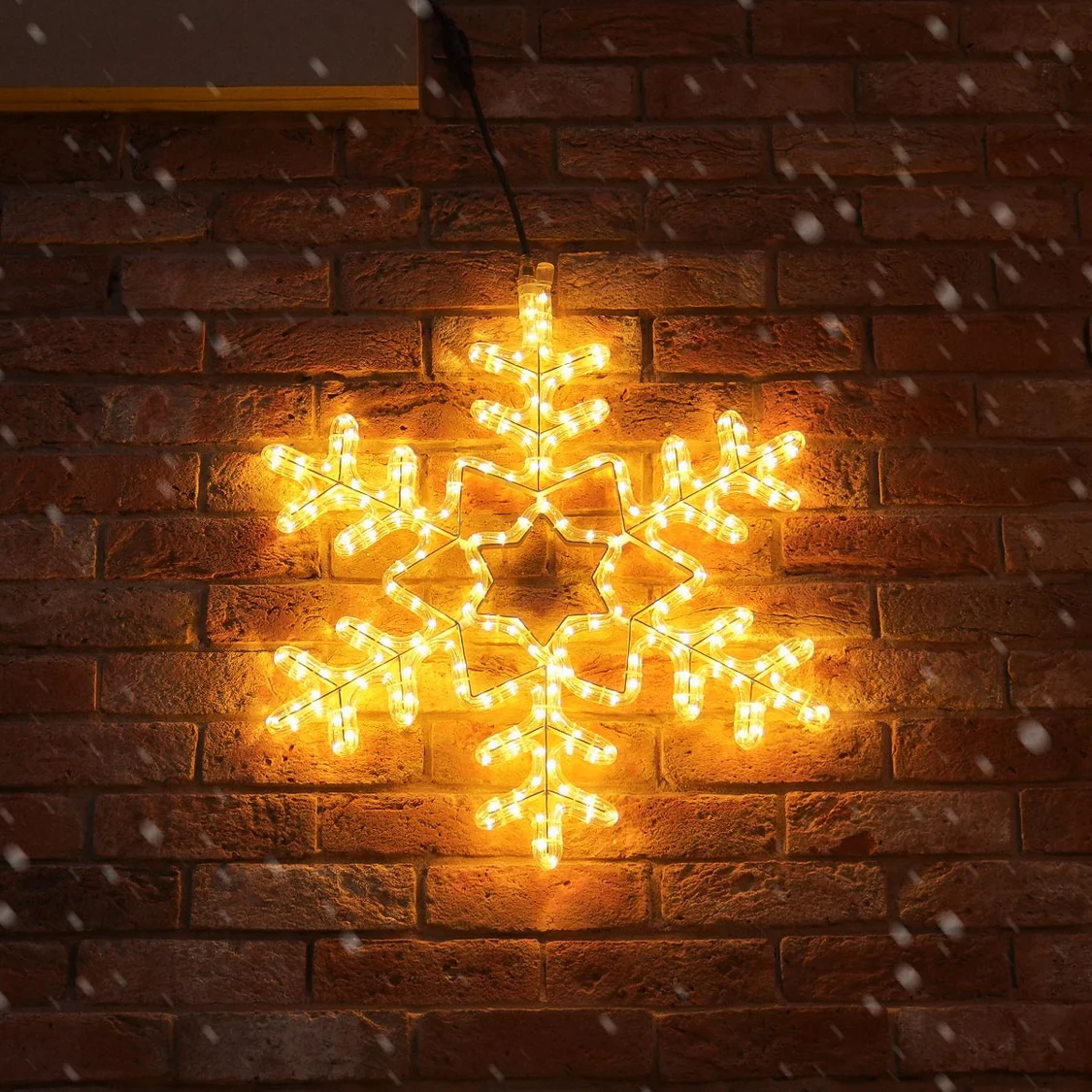
Outdoor Rope Light Snowflake Christmas Silhouette
An analysis from the supplier examines how the shift to LED lighting affects the cost of running a domestic Christmas display, using current electricity prices.
CHORLEY, CHARNAROCK RICHARD, UNITED KINGDOM, October 9, 2026 /EINPresswire.com/ -- Festive Lights, a United Kingdom-based supplier of domestic and commercial decorative lighting, has published an analysis of the running cost of a domestic Christmas lights display, set against the electricity price cap that took effect on 1 October 2026. The assessment examines how the transition from incandescent bulbs to light-emitting diode (LED) technology has changed the economics of festive lighting, and presents worked examples showing that a typical modern display can be operated for the festive season at a cost measured in pence or a small number of pounds.The analysis is directed at households approaching the seasonal decorating period amid continued attention to energy costs. From 1 October to 31 December 2026, the Ofgem price cap set a typical annual dual-fuel bill of £1,723 for a household paying by direct debit, an increase of around 4 percent on the previous quarter, with electricity capped at an average of 26.32 pence per kilowatt-hour. A temporary removal of VAT from domestic electricity, in effect from October 2026 to March 2027, held the electricity unit rate close to flat despite rising wholesale costs. Against that backdrop, the question of how much a Christmas display adds to a household bill has a direct bearing on decorating decisions.
From Incandescent Bulbs to LEDs
The principal factor behind the low running cost of modern displays is the near-complete replacement of incandescent bulbs by LEDs across decorative lighting. Traditional filament bulbs produce light by heating a wire, a process that consumes most of the energy drawn as heat rather than light. LEDs generate light far more efficiently, drawing a small fraction of the power for a comparable visual effect. Industry figures indicate that LED decorative bulbs use up to 90 percent less electricity than the incandescent equivalents they have replaced, a reduction that has transformed the cost of operating an extended display over several weeks.
The difference is most apparent when comparable lengths of lighting are set side by side. A modern LED string of around ten metres draws in the region of 3.5 watts, whereas an older incandescent set of similar length typically drew ten to twenty times as much. Across a full season of daily use, that gap separates a display costing a few pence to run from one costing several pounds, and it is the reason the running cost of festive lighting has receded as a practical concern for most households. The same efficiency now applies across the range, from string and fairy lights to the weatherproof outdoor figures sold as Christmas outdoor silhouettes lights.
"The conversation about whether Christmas lights are expensive to run is really a conversation about an older technology," said Stephen Alty, General Manager at Festive Lights. "Filament bulbs did draw meaningful power, and a large display could once be noticed on a bill. LEDs changed that completely. The figures now are so small that running cost is rarely the deciding factor in what people choose, and that is a genuine shift from where things stood a decade or two ago."
What a Display Actually Costs
Applying the October 2026 electricity rate to representative products produces figures that are modest by any measure. A ten-metre LED string rated at 3.5 watts, run for the six hours a night that the company identifies as a typical UK pattern, consumes about 0.021 kilowatt-hours a day. At 26.32 pence per kilowatt-hour, that equates to roughly half a penny a day, or in the region of 17 pence across the whole of December. A low-voltage LED fairy set rated at under one watt costs around a tenth of a penny a day to run on the same basis.
Larger displays scale accordingly but remain inexpensive. A twenty-metre set of LED cluster lights rated at 4.2 watts costs in the order of 20 pence to run across December at six hours a night. A combined display drawing on several connected elements, such as net lights, string lights, cluster lights and icicle lights across a house frontage, can be operated for the month for under £5 at current prices, according to the company's published worked examples.
These amounts are most easily understood by comparison with everyday appliances. Running a 150-watt television for a single evening draws more electricity than a modest LED light set consumes across the entire month of December. The company's own guidance frames a comprehensive outdoor display as costing less over a full month than a single takeaway meal, a comparison intended to place the figures in a familiar context rather than to make a promotional claim.
Factors That Affect the Figure
The analysis notes that running cost is not fixed and depends on three variables: the wattage of the lighting, the number of hours it operates, and the unit price of electricity, which varies by region, payment method and meter type. Standing charges, a fixed daily amount levied regardless of use, are separate from the unit cost and are not attributable to any individual appliance. The figures cited apply to LED products; displays still using older incandescent sets will cost considerably more to run.
Hours of operation are the variable most within a household's control. Reducing the time a display runs each evening lowers its cost proportionally, and the company notes that a plug-in timer, which switches a display on and off at set times, removes the need to leave lighting on longer than intended. The guidance observes that the same measure that reduces cost also addresses the common practice of leaving decorative lighting on overnight, when it serves little purpose.
"Because the per-unit figures are so low, the main thing a household can do to manage cost is simply to control the hours," said Jana Dalton, a specialist in exterior lighting at Festive Lights. "A timer set to run a display through the evening and switch off at bedtime keeps the cost down without anyone having to think about it. Checking the stated wattage before buying is the other practical step, because it is the figure that determines running cost, and it is not always given the prominence it deserves."
Popular Formats and the Range of Displays
The products that make up a domestic display span several formats, the majority of which are now LED and therefore subject to the same low running costs. String lights and fairy lights remain the most widely used, wrapped around trees, railings and house frontages. Cluster and net lights provide dense coverage over a defined area, while icicle lights are commonly hung along eaves and gutters.
Decorative figure and outline lighting has also become a prominent category. Silhouette lights, which trace a shape such as a star, tree or reindeer in a single line of illumination, are available in formats intended for different settings. Indoor designs, including indoor Christmas silhouettes lights, are typically positioned in windows and hallways, where the outline reads clearly through glass. Weatherproof designs for walls, gardens and house frontages are rated for exterior exposure. Both formats use LEDs and draw little power, placing their running cost on the same scale as the string and cluster lighting that surrounds them.
Timing and Planning
The analysis addresses the seasonal pattern of purchasing, noting that interest in Christmas lighting rises sharply from early October as households begin planning displays. Early selection allows buyers to compare products on specification, including the stated wattage that governs running cost, rather than on availability alone as stock narrows closer to December. For connected systems, planning the full extent of a display in advance allows the correct number of compatible sets and accessories to be acquired together, avoiding mismatched additions later.
The company states that it publishes wattage figures in the specifications of its connectable products and provides an online calculator that estimates the running cost of a given display from its wattage, hours of use and the user's electricity unit rate. The stated purpose is to allow households to establish the cost of a specific planned display rather than relying on general assumptions about festive lighting.
Market Context
The low running cost of LED displays sits within a wider pattern in which decorative lighting has continued to expand as a category despite sustained attention to household energy use. The efficiency of LED technology has effectively removed running cost as a barrier to extended displays, shifting the basis of purchasing decisions towards design, durability and the initial price of the products. Commentators expect this pattern to continue as LED efficiency improves further and as connected and controllable systems allow displays to be scheduled and dimmed with greater precision.
Festive Lights states that its analysis is intended to give households accurate, current figures with which to assess the cost of a Christmas display, distinguishing the modest running cost of modern LED lighting from assumptions carried over from the era of incandescent bulbs. The company notes that running costs depend on the specific products, usage and tariff involved, and that the figures cited are illustrative examples based on the October 2026 price cap rather than a guaranteed cost for any particular household.
About Festive Lights
Festive Lights is a United Kingdom-based supplier of exterior and interior decorative lighting, focusing on the distribution of connectable LED string and festoon systems, solar-powered fixtures, battery-operated lighting, application-controlled smart lighting and motion-sensor units for residential and commercial use. The company supplies both consumers and professional installers, publishes wattage and running-cost information for its connectable ranges, and manufactures its products to defined weatherproofing standards. Established for over two decades and based in Charnock Richard, Chorley, the organisation maintains an emphasis on product durability, weatherproofing certification and accessible installation.
Jana Dalton
Festive Lights
1257792111 ext.
Visit us on social media:
LinkedIn
Instagram
Facebook
YouTube
TikTok
X
Other
Legal Disclaimer:
EIN Presswire provides this news content "as is" without warranty of any kind. We do not accept any responsibility or liability for the accuracy, content, images, videos, licenses, completeness, legality, or reliability of the information contained in this article. If you have any complaints or copyright issues related to this article, kindly contact the author above.
