
Beyond energy prices: the ripple effects of Gulf supply disruptions
By Pablo Aguilar, Lukas Boeckelmann and Antoine Kornprobst
How vulnerable is the global economy to trade disruption in the Strait of Hormuz? Using scenario-based analyses, this blog shows that supply shortages can affect growth and inflation beyond the impact on global energy prices.
The war in the Middle East and the subsequent closure of the Strait of Hormuz have unsettled oil markets. Energy prices have surged, causing great uncertainty across the global economy. Moreover, physical disruptions to exports of energy and other non-energy goods from Gulf countries represent an additional channel that could have international macroeconomic repercussions. Disrupted imports of energy products, petrochemicals and other key intermediate goods from Gulf countries could lead to shortages in essential inputs if they cannot be replaced because domestic strategic reserves are unavailable, for instance, or inventories have been run down. Importing economies would then face difficulties with their production processes. And these, in turn, could create knock-on effects that ripple through global supply chains. This could cause growth to weaken further and inflation to rise faster.
Though tensions have eased recently and immediate threats to Gulf trade flows appear to have somewhat receded, the Strait of Hormuz remains a key chokepoint for the global supply of energy. This blog illustrates how sensitivity analysis around energy prices can complement the use of scenarios to capture potential knock-on effects of trade disruption. Among other results, our estimates show that persistent input shortages of energy goods alone could put up to 3% of euro area production at risk.
Exposure is concentrated in Asia and energy-intensive sectors
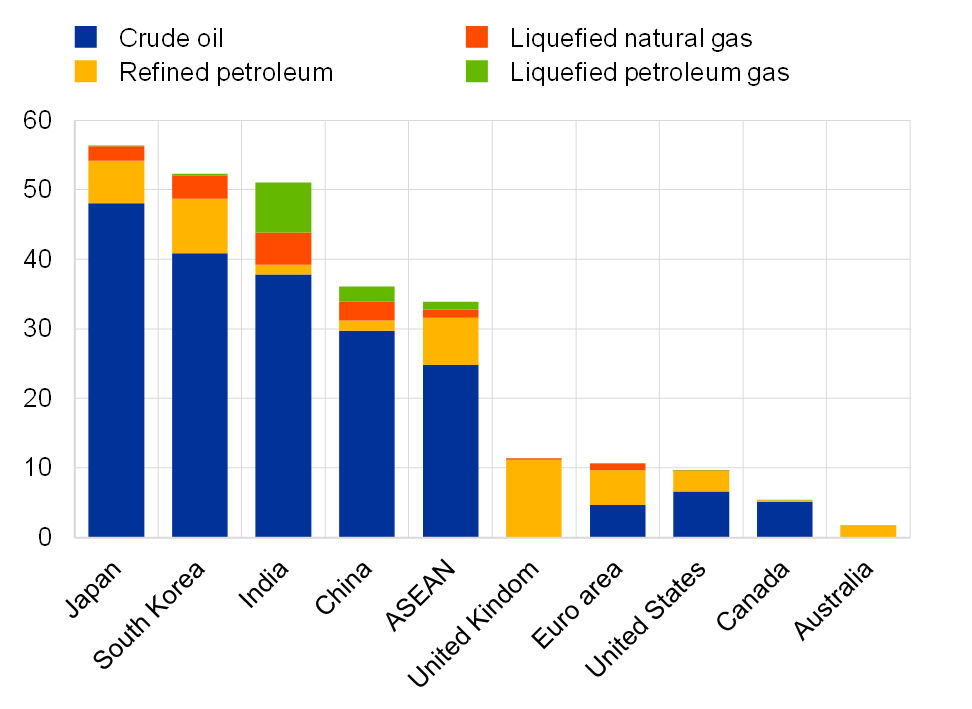
Dependence on Gulf energy supplies varies markedly across countries. Asian economies are the most exposed. Gulf suppliers account for over 50% of total energy imports in Japan, South Korea and India, and around one-third in China and ASEAN economies.[1] The equivalent figure for the euro area, the United Kingdom and the United States is only around 10% (Chart 1, panel a). Exposure also differs across sectors. Unsurprisingly, energy-intensive industries – notably petrochemicals, aluminium, fertilisers and semiconductors – are particularly vulnerable. From there, disruption could spill over to manufacturing and processing sectors through global production networks. Given the role of Asia as a global manufacturing hub, declining industrial output in the region could have a widespread impact.
By contrast, risks from disrupted exports of industrial and other goods from Gulf countries appear more contained. These goods account for less than 1% of total non-energy imports for most advanced and emerging market economies, with India a notable exception (Chart 1, panel b). When bottlenecks arise in key industrial inputs, however, these again could lead to knock-on effects within value chains. So, for products where Gulf countries have a large global footprint, such as fertilisers, aluminium and petrochemicals, these risks of knock-on effects are nevertheless substantial. For example, disruption to Gulf supplies could remove around one-third of global helium production and one-fifth of global methanol production. This could severely affect related sectors, such semiconductors, aerospace and industrial inputs, particularly in Asia.[2]
Chart 1
Imports from Gulf countries
a) Energy imports |
b) Non-energy imports |
|---|---|
(percentage of total energy imports, 2025) |
(percentage of total non-energy imports, 2025) |
 |
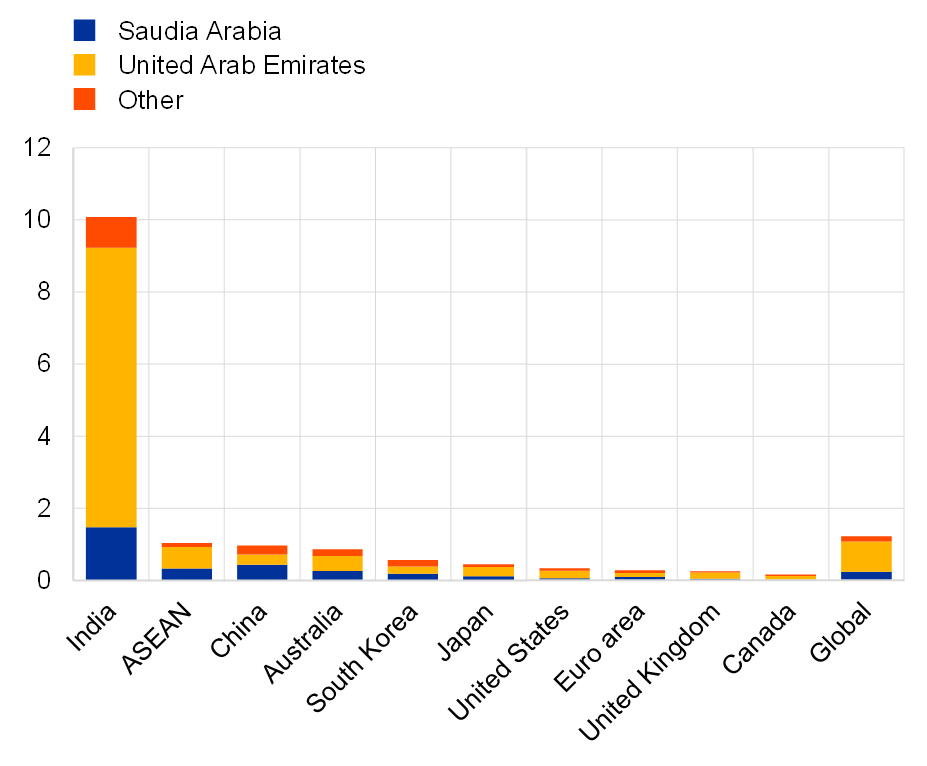 |
Sources: Trade Data Monitor and ECB staff calculations.
Notes: “Gulf countries” comprises Iran, Iraq, Kuwait, Saudi Arabia, United Arab Emirates and Qatar. Panel b) plots the non-energy import exposure of major advanced and emerging economies.
Quantifying risks: energy and broader supply disruptions
To understand these effects better, we quantify risks for two different potential developments related to exports from the Gulf countries: a scenario with disruption to energy goods, and a broad scenario where the flow of industrial and other goods is also disrupted.
The first scenario assumes that exports of energy goods from the Gulf, including gas, crude oil and refined petroleum products, are fully and persistently disrupted. We also assume domestic buffers, such as strategic oil and gas reserves, are not available to shield households and firms from the energy supply crunch.
The second, broad disruption scenario extends the shock to exports of industrial and other goods from Gulf countries. This includes items such as fertilisers and helium. While we assume that in the first scenario, firms may be able to substitute inputs with alternative sources of energy, in the second case, import substitutability is more limited. This second scenario highlights the vulnerability of global supply chains and the international transmission of the supply shock.
Eurosystem staff have already incorporated the effects of rising global energy prices on growth and inflation in the severe Middle East scenario in the June 2026 macroeconomic projections for the euro area.[3] Our two disruption scenarios capture the additional losses from fragmented energy markets and physical shortages, depending on direct and indirect trade links with Gulf countries.[4]
We assess these scenarios using two modelling approaches, which are complementary in their ability to quantify cross-country exposures to supply disruptions and medium-term fluctuations.
The first model is a static multi-country, multi-sector trade framework. It traces how persistent supply disruptions originating in specific regions and goods affect production networks and economic activity.[5] It is calibrated on a large set of advanced and emerging economies with input-output linkages across sectors and countries.[6] Our estimates for output at risk have an upper and lower bound, depending on whether producers can easily substitute disrupted imports. This enables us to gauge two situations: one in which firms can easily replace inputs (best‑case estimate of damage), and one where production fails to adjust quickly (worst-case estimate of damage).
Second, we use a detailed, dynamic model that includes slow price changes, central bank reactions, and supply chains to see how shocks affect growth and inflation over time.[7]
Energy disruptions pose the greatest macroeconomic risks
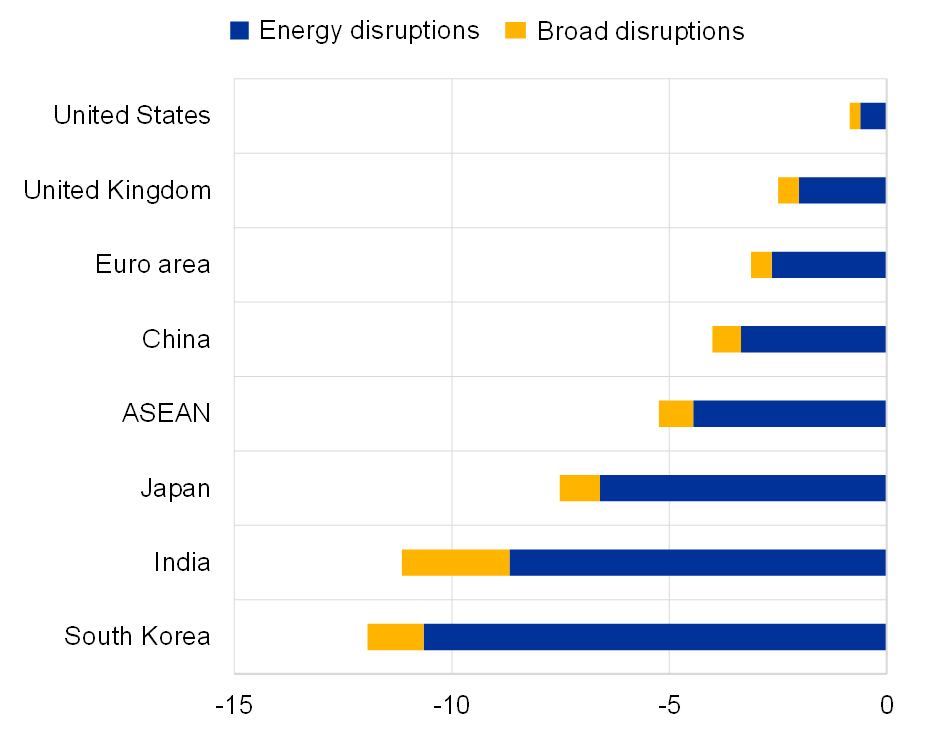
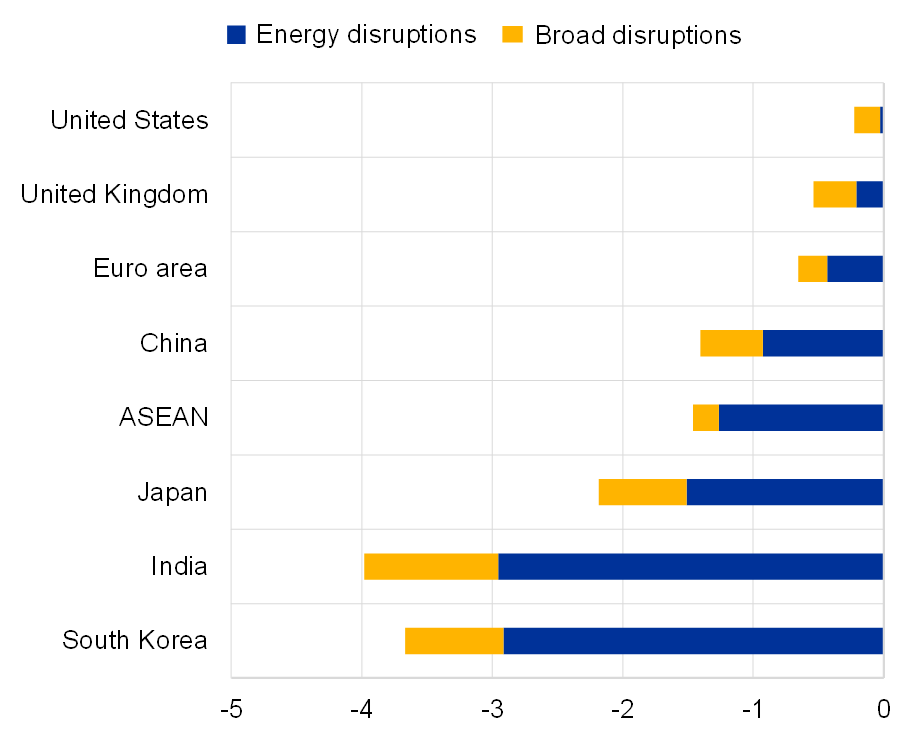
The static analysis shows that Asian economies would face the largest production losses in the energy disruption scenario, led by South Korea (up to 11%), India (around 8%) and Japan (around 7%), followed by ASEAN economies (up to 5%) (Chart 2, panel a). Losses for the euro area are smaller but still material, reaching up to 3%. The additional damage due to shortages of non-energy goods assumed in the broad scenario is generally limited for most advanced economies but more pronounced for India. If we assume that producers are better able to substitute missing inputs, losses are much milder; for example, euro area production losses amount to 0.4% in the energy disruption scenario and 0.6% in the broad disruption scenario (Chart 2, panel b).
Chart 2
Output at risk from energy disruptions
a) Output at risk from energy disruptions – upper bound |
b) Output at risk from broad disruptions – lower bound |
|---|---|
(percentage change in production compared with pre-shock period) |
(percentage change in production compared with pre-shock period) |
 |
 |
Sources: OECD TiVA, Baqaee and Farhi (2024) and ECB staff calculations.
Notes: Non-linear impact simulated through 25 iterations. In panel a), the output effects are computed based on a calibration of the model with short-run substitution elasticities, as in Boehm et al. (2023). In panel b), the output effects are computed based on a calibration of the model with medium- to long-run substitution elasticities, as in Fontagné et al. (2022).
Physical disruptions amplify impact on growth and inflation (especially for China)
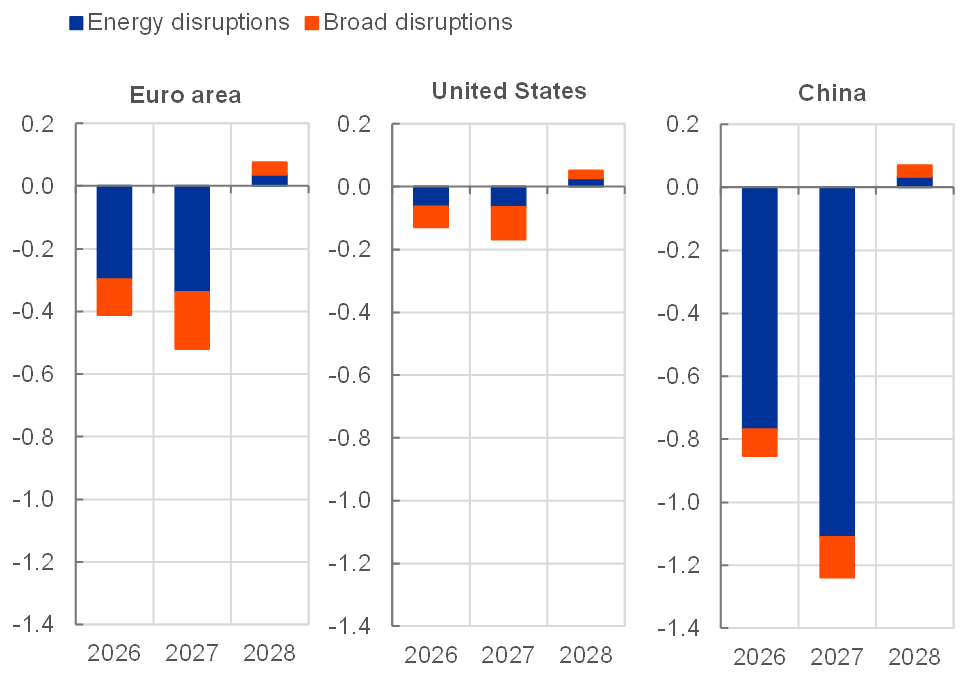
The dynamic simulations show that beyond the effect of the closure of the Strait of Hormuz on global energy prices, energy disruptions may lower GDP and push up price inflation. China would be more severely affected than the euro area or the United States. This reflects China’s greater exposure to Gulf-origin oil and gas inputs. The peak impacts on GDP and inflation would occur in 2027, but with significant adverse effects on growth already felt in 2026 and inflation persisting through 2028. In 2026 and 2027 GDP growth is projected to be 0.8 and 1.1 percentage points lower in China, and 0.3 percentage points lower in the euro area and 0.1 percentage points lower in the United States in both years (Chart 3, panel a).
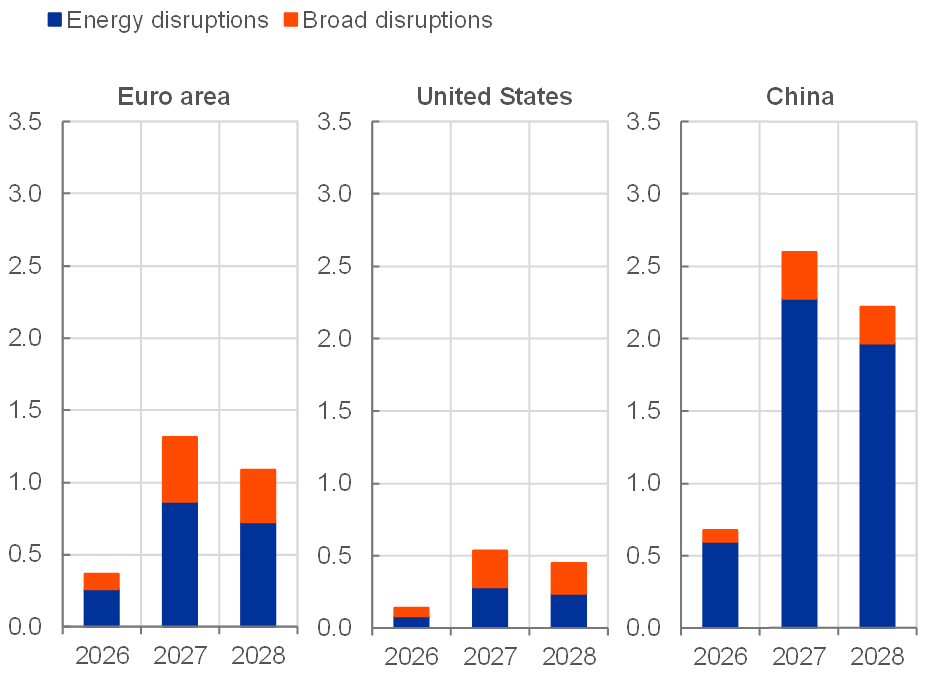
Consumer price inflation is also projected to be higher, peaking in 2027 at to 2.3 percentage points in China, 0.9 percentage points in the euro area and 0.3 percentage points in the United States (Chart 3, panel b). While the effect on economic activity partly unwinds after the initial loss, inflation remains persistently higher. This is because energy production capacity is affected by the curtailing of Gulf energy exports, with after-effects rippling through supply chains as shortages of intermediate inputs lead to broader price hikes.
In the broad disruption scenario, restrictions on non-energy inputs further amplify the effects and make inflation more persistent, peaking 2027. The mechanism matters, because some Gulf-origin inputs are difficult to substitute and are located upstream in production networks. A combination of the two disruption scenarios would lower GDP growth by around 0.4 percentage points in the euro area in 2026, 0.9 percentage points in China and 0.1 percentage points in the United States (Chart 3, panel a) and raise inflation by 1.3 percentage points in the euro area, 2.6 percentage points in China and 0.5 percentage points in the United States at the peak in 2027 (Chart 3, panel b).
Chart 3
Additional GDP and inflation effects from physical supply shortages
a) Real GDP growth |
b) Consumer price inflation |
|---|---|
(percentage point deviation from projected growth rate) |
(percentage point deviation from projected growth rate) |
 |
 |
Sources: Aguilar et al. (2026), June 2026 Eurosystem staff macroeconomic projections and ECB staff calculations.
Notes: “Energy disruptions” mimics disruptions to Gulf energy supply. “Broad disruptions” extends supply restrictions to Gulf-origin non-energy inputs. The charts show GDP and inflation effects for the two disruption layers. Effects are expressed as percentage point deviations from the effects of a global commodity price shock on annual growth rates, consistent with the severe Middle East scenario in the June 2026 Eurosystem staff macroeconomic projections.
Why supply chains matter
Overall, the simulations highlight how scenario analysis makes it possible to assess the macroeconomic implications of geopolitical risks that go beyond the direct effects of higher energy prices and uncertainty.
Although the recent easing of tensions reduces the likelihood of the specific Gulf disruption scenario considered here materialising, the exercise underscores that if geopolitical shocks were to impair the physical supply of energy and other intermediate inputs, the macroeconomic costs could rise materially through global production networks. These risks would be larger should disruptions prove persistent, particularly if countries depleted energy reserves and firms faced tighter constraints in sourcing critical inputs.
The analysis therefore points to the importance of monitoring both direct energy exposure and indirect supply-chain dependencies, preserving adequate buffers and strengthening contingency planning for sectors that rely on hard-to-substitute upstream inputs. More broadly, it illustrates how scenario analysis can complement baseline projections by tracing the channels through which geopolitical shocks may affect output and inflation.
The views expressed in each blog entry are those of the author(s) and do not necessarily represent the views of the European Central Bank and the Eurosystem.
Check out The ECB Blog and subscribe to receive future posts via email.
For topics relating to banking supervision, why not have a look at The Supervision Blog?
References
Aguilar, P., Darracq Pariès, M., Dieppe, A., Eugenelo, A., Gallegos, J.-E., Domínguez-Díaz, R. and Quintana, J. (2026), “US-China decoupling and the euro area: assessment from a Global Production Networks Macroeconomic Model”, Working Paper Series, ECB, forthcoming.
Attinasi, M.G., Boeckelmann, L. and Meunier, B. (2025), “The economic costs of supply chain decoupling”, The World Economy, Vol. 48(3), pp. 598-627.
Baqaee, D. and Farhi, E. (2024), “Networks, Barriers, and Trade”, Econometrica, Vol. 92(2), pp. 505-541.
Boehm, C.E., Levchenko, A.A. and Pandalai-Nayar, N. (2023), “The Long and Short (Run) of Trade Elasticities”, American Economic Review, Vol. 113(4), pp. 861-905.
ECB (2026), “Eurosystem staff macroeconomic projections for the euro area, June 2026”.
Fontagné, L., Guimbard, H. and Orefice, G. (2022), “Tariff-based product-level trade elasticities”, Journal of International Economics, Vol. 137.
Goldman Sachs (2026), “Supply Shocks from the War in Iran Are Mostly Limited to Energy”, Goldman Sachs Global Economics Comment, 15 March.
Legal Disclaimer:
EIN Presswire provides this news content "as is" without warranty of any kind. We do not accept any responsibility or liability for the accuracy, content, images, videos, licenses, completeness, legality, or reliability of the information contained in this article. If you have any complaints or copyright issues related to this article, kindly contact the author above.
