

A tale of two energy crises – initial conditions matter
3 June 2026
By Óscar Arce, Niccolò Battistini, Othman Bouabdallah, Eliza Lis and Matthias Mohr
The current energy shock is significant and global, but it is also hitting a euro area economy that is more balanced than when Russia invaded Ukraine in early 2022. History and analysis show that context matters a lot for how shocks propagate to inflation.
Energy prices have risen sharply since early 2026 when war broke out again in the Middle East and the Strait of Hormuz was closed. This big uptick in energy inflation has in turn driven up headline inflation in the euro area, to stand at 3.2% in May.
This blog post takes a close look at two dimensions that are relevant for the propagation of an energy shock: (i) the nature and composition of the shock itself, and (ii) the state of the economy and the broader macro-financial condition at the outset.
This shock is different
The current energy shock differs in nature and composition from the episode that followed Russia’s invasion of Ukraine in February 2022. Unlike in 2022, the Middle East war has sparked more disruption in the supply of oil, rather than of natural gas, to the euro area. Indeed, the upsurge in crude oil prices has been faster and pressure on prices of some refined oil products, like diesel, has been larger in the latest episode than in 2022, while wholesale gas and electricity prices rose much more in 2022 (Chart 1). The difference in the reaction of gas and electricity prices for the most part reflects how Europe was more directly exposed to the shock in 2022 and was less prepared.
Chart 1
Developments in energy prices across components
(panel a: USD/Bbl, panel b: EUR/MWh, panel c: EUR/MWh)
Sources: Refinitiv and ECB staff calculations.
Notes: Monthly data over the months of each year. The vertical line indicates Russia’s full-scale invasion of Ukraine and the outbreak of the war in the Middle East. The latest observations are for May 2026.
Moreover, some structural changes in the euro area energy mix since 2022 also imply that the direct sensitivity of consumer prices to a given wholesale energy price shock has declined. The clearest example of this is the increasing cushioning role of electricity generated from renewable sources. While wholesale electricity prices tracked gas prices closely during the 2021-22 energy crisis, their reaction since the start of the war in the Middle East has been far more muted.[1]
While these differences point towards a less broad-based energy shock, other factors point in the opposite direction. In particular, oil supply shocks propagate to consumer inflation faster than gas supply shocks do. Rising crude oil prices transmit rapidly to what consumers pay at the pump, and rising prices tend to pass through stronger than falling prices. By contrast, it can take several months before increases in wholesale gas and electricity prices are reflected in consumers’ utility bills.[2] Seen from another angle, the current shock is more global in nature than the 2022 episode. A global shock has larger indirect effects on inflation, as cost pressures build more broadly along global value chains. This, in turn, causes import prices to rise more sharply and the energy price shock to transmit stronger to the domestic economy.[3]
Initial economic conditions matter
Beyond the nature of the shock itself, the starting macro-financial environment plays a key role in the propagation of an energy shock into underlying inflation. The pass-through tends to be stronger when the level of the inflation rate is higher, demand conditions are more robust, the labour market is tighter and fiscal and monetary policy are more expansionary. Along each of these dimensions, today’s starting point differs substantially from early 2022.
Starting inflation environment
When Russia invaded Ukraine in February 2022, euro area headline inflation, as measured by the Harmonised Index of Consumer Prices (HICP), was growing at between 5% and 6% year on year and was accelerating (Chart 2, panel a). Energy inflation had already been climbing steeply from around 15% since mid-2021 to slightly above 30% in February 2022 due to a combination of surging post-pandemic demand and Russia curtailing gas supplies ahead of the invasion. When the current shock hit in late February 2026, headline inflation stood slightly below 2% − close to the ECB’s medium-term target − with energy and core inflation momentum at moderate levels.
The initial level of inflation when a shock hits matters a great deal. There are several reasons for this. The pass-through of energy price increases to consumer inflation can be amplified when inflation is already high. When price pressures are contained, firms tend to absorb small cost increases rather than reprice. But in a high-inflation environment, waiting too long risks eroding margins excessively. As a result, firms are more likely to increase the frequency of price adjustments, leading to more persistent inflationary pressures.[4] Starting from a position of inflation close to target thus reduces the risk of the initial energy price spike triggering a disproportionate reaction by price- and wage-setters.[5] Furthermore, households and firms may also now be paying closer attention to inflation after the recent experience of a high inflation episode. When attention is high, expectations are more sensitive to developments, potentially amplifying the inflationary impact of the shock.[6]
Chart 2
Developments in overall HICP headline
(annual percentage changes)
Source: Eurostat.
Notes: The vertical line indicates Russia’s full-scale invasion of Ukraine and the outbreak of the war in the Middle East. Core inflation stands for HICP inflation excluding energy and food. The latest observations are for May 2026.
Demand and supply conditions
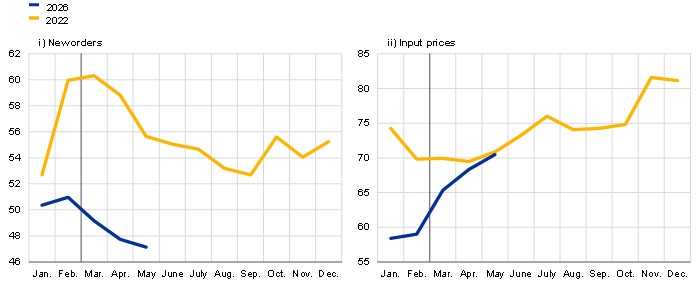
When Russia invaded Ukraine, global and domestic demand was robust following the lifting of most pandemic restrictions.[7] The composite Purchasing Managers’ Index (PMI) for new orders stood firmly in expansionary territory at the start of 2022 (Chart 3, panel a). When the current shock hit, by contrast, new orders were already hovering around the no-change threshold of 50, pointing towards subdued rather than strong demand. A similar divergence is visible in cost pressures. Input prices were already elevated at the beginning of 2022, amid pandemic-related bottlenecks. In 2026, they started from a much lower base.
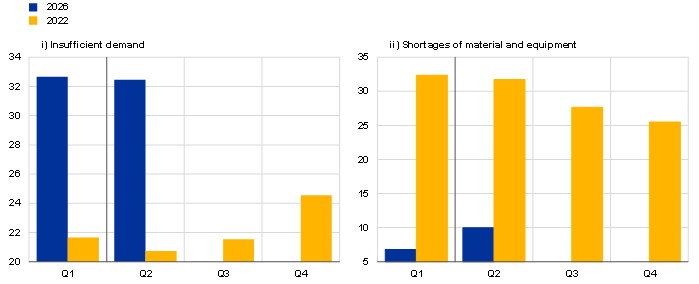
The European Commission’s business surveys on the factors limiting production tell a similar story.[8] In 2022, firms overwhelmingly reported shortages of material and equipment as the main binding constraint on the supply side, while insufficient demand was cited only rarely (Chart 3, panel b). In 2026, this pattern essentially reversed. This means that not only are demand-pull and cost-push inflationary forces weaker than in 2022, but the balance had tilted away from a binding supply side towards a more demand-constrained economy before the outbreak of the war in the Middle East.
Chart 3
Business survey indicators for demand and supply developments in 2026 and 2022
|
a) Composite PMI (diffusion index around the no-change value of 50) |
 |
|
b) European Commission’s composite business survey (balance, percentage) |
 |
Sources: S&P Global and European Commission.
Notes: The vertical bars separate the observations preceding and those following Russia’s invasion of Ukraine (2022) and the initial strikes on Iran (2026). The European Commission’s composite business survey in panel b) refers to a weighted average of the corresponding indicators for the manufacturing and services sectors. The weighting scheme follows the Commission’s official guidelines (i.e. 40% on manufacturing and 30% on services, rescaled to sum to 100%).
Labour market conditions
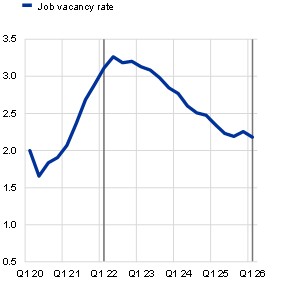
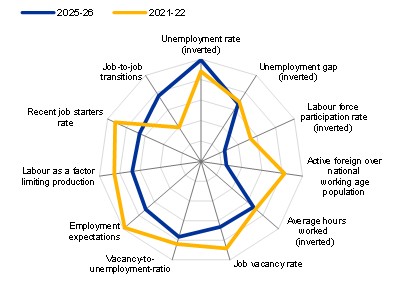
Labour demand has eased significantly in the last four years. Firms have reduced the number of job openings to pre-pandemic levels, with the vacancy rate falling to 2.2% in the first quarter of 2026 from its high records at the end of 2021 (Chart 4, panel a). By contrast, labour supply has improved compared with 2022, as more national workers have joined the labour force and immigration of foreign workers has risen. Also, workers are now working slightly more hours on average. The combination of declining labour demand and steadily increasing labour supply has led, in turn, to a marked decline in labour shortages reported by firms.
Chart 4
Labour market conditions
a) Job vacancy rate |
b) Labour market tightness indicators |
 |
 |
Sources: Eurostat, European Commission, ECB (CES) and ECB staff calculations.
Notes: All indicators in panel b) are scaled such that the outer circle of the radar chart corresponds to the “tightest” and the inner circle to the “least tight” outcome of each indicator. The “tightest” outcome is defined for each variable either as the lowest level recorded since Q1 2005, which applies to all variables related to unemployment, the participation rate, the ratio of active foreign to national working-age-population and average hours worked, or, otherwise, as the highest level recorded since Q1 2005. The “least tight” outcome is defined conversely to the “tightest” outcome. The job-to-job transition rate has been computed on the basis of the CES. Average hours worked and the job-to-job transition rate are smoothed as four-quarter averages.
Although job matching has improved since 2022, labour market dynamism has weakened. While the job-to-job transition rate – the share of workers changing jobs each quarter – is marginally higher than at the start of 2022, this indicator is outweighed by the broader evidence of reduced labour market tightness depicted in Chart 4, panel b. By contrast, the overall number of recent job starters is now lower than when Russia invaded Ukraine. This points to a gradual loss of momentum in the labour market over recent years, which has facilitated a sustained moderation in wage growth rates.[9]
Fiscal and monetary policy stance
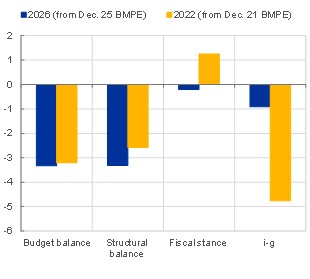
The euro area headline fiscal positions looked broadly similar at the onset of each of the two energy crises, with governments expected to run deficits of 3.2% of GDP in 2022 and 3.3% in 2026.[10] However, a closer look reveals how different fiscal policy actually is today.
The euro area entered the 2022 energy crisis buoyed by large fiscal stimulus and strong monetary policy accommodation during the pandemic, which helped to sustain demand then and in the subsequent years.[11] By contrast, the fiscal and monetary policy stance was broadly neutral when the 2026 energy crisis erupted.
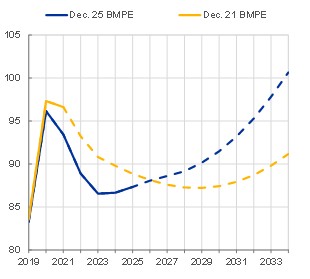
At the same time, room for fiscal manoeuvre is more limited today than in 2022. Stripping out cyclical and other temporary factors, the structural fiscal deficit projected for 2026 is larger, at 3.3%, than the 2.6% projected for 2022.[12] Moreover, pre-crisis government plans entailed a substantial consolidation in 2022 following the discontinuation of some pandemic-related support.[13] That freed up additional fiscal space that could be used to respond to the energy shock. In 2026, fiscal stances are already loosening in several countries, most notably in those with available fiscal space such as Germany and the Netherlands.[14] In turn, this leaves considerably less room to implement additional measures to support households and firms (Chart 5, panel a). The debt outlook is now also less favourable. Although the aggregated euro area government debt ratio was broadly comparable at the start of the two episodes, the cost of debt refinancing has increased materially. In 2022, sovereign borrowing costs were near historic lows and the interest rate-growth differential was still negative in most euro area countries. By 2026, with policy rates and term premia higher, that fiscal buffer has largely dissipated and medium-to-long-term debt projections now point to significantly more adverse dynamics (Chart 5, panel b).
Chart 5
Fiscal positions prior to 2026 and 2022 energy crises
(panel a: budget balance and structural balance: percentages of GDP, fiscal stance: percentages of potential GDP, interest rate-growth differential (i-g); percentage points; panel b: percentages of GDP)
a) Euro area budgetary indicators |
b) Euro area debt outlook |
 |
 |
Sources: Eurosystem staff macroeconomic projections for the euro area, December 2021 and December 2025, and related Debt Sustainability Analyses.
Notes: BMPE stands for Broad Macroeconomic Projection Exercise, as reflected in the Eurosystem staff macroeconomic projections for the euro area. The dashed segments in panel b) represent projected values. These replicate the BMPE figures until the end of the BMPE horizons (t+3) and are extended assuming constant structural balances net of ageing costs.
Limited fiscal space requires a more muted and targeted fiscal response to the 2026 crisis. This may, on the one hand, keep the demand-driven inflationary impact of fiscal policy contained. On the other hand, it reduces the scope for measures aimed at mitigating inflation in the near term, such as introducing price caps.
Conclusions
The current energy shock is significant. Headline inflation has moved above target. At the same time, the present episode is unfolding under conditions that are clearly different from those observed during the 2022 crisis.
Some features point towards lower inflationary risks now than they did in 2022. The shock is now predominantly an oil shock rather than a gas shock, and the increase in the share of electricity generated from renewables and nuclear provides a buffer for consumer electricity prices. Inflation was close to target when the current shock struck, and inflationary momentum was not rising. Both demand conditions and supply conditions appear less inflationary now. The labour market looks less tight overall. And the monetary-fiscal policy mix is more neutral while fiscal space is narrower, limiting the capacity that governments have to provide additional support that could stimulate demand.
That said, a number of other initial conditions flag larger inflationary risks now compared with 2022. Constrained fiscal space implies less room to cushion the impact of the energy shock on inflation in the near term. Moreover, the current shock is global, which raises the risk of strong non-linear amplification, should the shock prove larger, broader or more persistent than currently expected. Finally, the recent experience of households and firms with high inflation may shape how strongly the current energy shock feeds through to inflation, albeit with an intensity that is hard to predict.
Overall, the current energy shock is unfolding in a context that differs markedly from four years ago. This calls for close monitoring of its effects on broader inflation dynamics, with particular attention being paid to the specific macro-financial features of the euro area today.
The views expressed in each blog entry are those of the author(s) and do not necessarily represent the views of the European Central Bank and the Eurosystem.
Check out The ECB blog and subscribe for future posts.
For topics relating to banking supervision, why not have a look at The Supervision Blog?
Legal Disclaimer:
EIN Presswire provides this news content "as is" without warranty of any kind. We do not accept any responsibility or liability for the accuracy, content, images, videos, licenses, completeness, legality, or reliability of the information contained in this article. If you have any complaints or copyright issues related to this article, kindly contact the author above.
